Top 5 Consumer & Prosumer Indoor Air Quality Monitors for 2026
Indoor air quality has a direct impact on our health and comfort, so having a reliable IAQ monitor at home or in a small office is increasingly important. In this 2026 edition, we rank the top five consumer/prosumer IAQ monitoring devices available in the U.S., focusing on models that are accurate, easy to use, and feature-rich for homeowners and small contractors. We scored each device across six categories (1–10 points each, max 60):
- Sensor Breadth & Accuracy: Pollutants measured (e.g. PM2.5, CO₂, VOCs, etc.), sensor technology (NDIR, laser, electrochemical, etc.), and calibration/accuracy.
- Certifications & Compliance: Relevant standards or certifications (EPA Indoor AirPLUS, UL/ETL safety, WELL/LEED readiness, etc.).
- Smart Features & Dashboard: Quality of mobile apps/web dashboards, real-time alerts, data logging, and user interface.
- Deployment & Integration: Ease of setup, power options (battery/wired), connectivity (Wi-Fi/Bluetooth), and smart home integration (Alexa, Google, IFTTT, etc.).
- Support & Reliability: Warranty, firmware updates, brand reputation, and customer support.
- Value for Users: Feature-to-price ratio and overall value for typical consumers.
Each monitor profile below includes a brief overview, pros and cons, the ideal use-case, and a scorecard breakdown. Following the profiles, you’ll find a comparison table and a 🧭 Which IAQ Monitor Should You Choose? guide to help decide which monitor fits your needs best.
🥇 Airthings View Plus – Best Overall w/ Radon & Comprehensive Sensors (56/60)
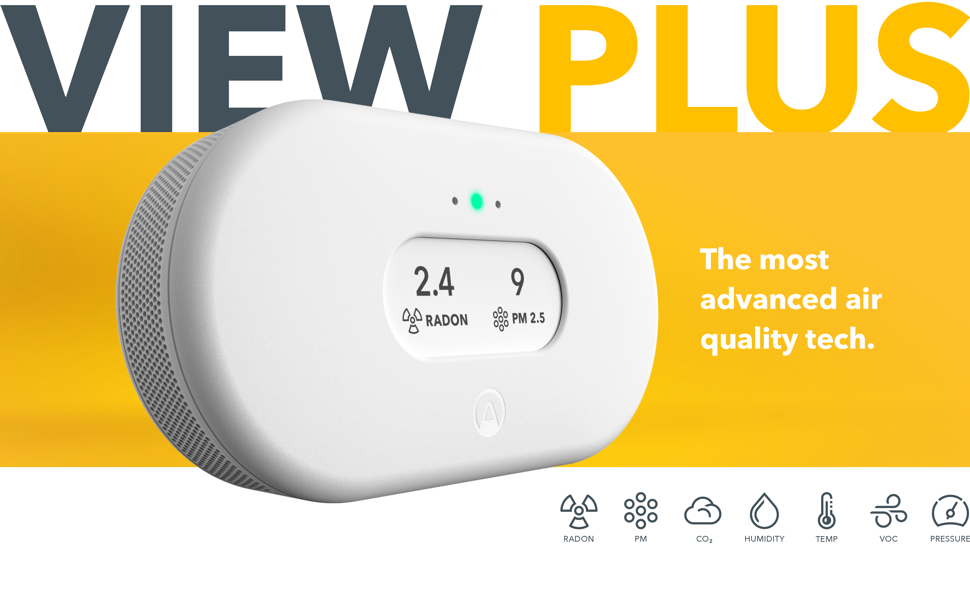
Airthings’ View Plus is a feature-packed, 7-in-1 air quality monitor that uniquely includes a radon sensor alongside all the usual IAQ suspects. Designed in Norway, the View Plus provides broad coverage of indoor pollutants – from fine particulate matter to CO₂ and VOCs – all presented on an e-ink display for at-a-glance readings. It’s Wi-Fi connected for anytime access via the Airthings app or web dashboard, and it even runs on batteries (up to ~2 years) or USB power for flexible placement. The device integrates with major smart home platforms (Alexa, Google Assistant, IFTTT) for automation and voice queriesairthings.com. With Airthings’ reputation in radon detection, the View Plus is especially suited for homeowners wanting a professional-grade yet user-friendly monitor covering every important metric.
Pros:
- Comprehensive sensing: Detects radon, CO₂, PM2.5, VOCs, humidity, temp, & pressure – more parameters than any other consumer IAQ device. This breadth, including the health-critical radon gas, sets it apart.
- User-friendly display: Large customizable e-ink screen shows key readings and color-coded air quality status at a glance. No phone needed for basic info.
- Cloud-connected & smart home ready: Wi-Fi connectivity with a robust app featuring trend graphs and insights. Supports Alexa, Google, and IFTTT for alerts or automations (e.g. turning on a purifier when PM spikes)airthings.com.
- Flexible placement: Can operate wirelessly on 6 AA batteries (battery life ~1.5–2 years) or via USB-C power. Mount it on a wall or place on a table; it even doubles as a hub for other Airthings sensors.
- Strong brand support: Backed by a 5-year warranty (with registration) airthings.com and Airthings’ established support network. Regular firmware updates and an online dashboard add long-term value.
Cons:
- Pricey investment: With an MSRP around $299, it’s one of the more expensive home IAQ monitors. You pay for the radon capability and build quality, but it may be overkill if radon isn’t a concern in your area.
- Data interval limits: To conserve power, the View Plus samples less frequently than some competitors (reading intervals are more spaced out, especially on battery). Rapid changes in air quality might not display in real-time (though the app provides periodic updates).
- No direct export without cloud: While you can view data in the app or Airthings web dashboard, there’s no native feature to export raw data locally. Accessing history requires using their cloud services (though integrations or APIs can pull data).
- No dedicated CO sensor: It measures a wide array of metrics, but carbon monoxide is not one of them. Homes should still rely on a CO alarm for safety (View Plus focuses on longer-term IAQ indicators).
Ideal Use-Case: Health-conscious homeowners who want all-in-one monitoring, including radon. Great for basements or older homes where radon is a risk, and for tech-savvy users who will leverage the smart integrations and detailed analytics.
Scorecard: (Total 56/60)
- Sensor Breadth & Accuracy: 10/10 – Unmatched range of sensors (only monitor with radon detection in this class) and generally high accuracy.
- Certifications & Compliance: 9/10 – CE/FCC/ETL certified; radon sensor performance validated by professional radon labs. A strong tool for meeting EPA Indoor AirPLUS radon requirements or WELL building standards.
- Smart Features & Dashboard: 9/10 – Excellent app with charts, customizable display, and rich integrations (Alexa, Google, IFTTT)airthings.com. Lacks HomeKit support, but otherwise top-tier.
- Deployment & Integration: 10/10 – Wi-Fi enabled, battery-powered option, and effortless setup. Integrates as a central hub with other Airthings devices and plays nicely in smart homes.
- Support & Reliability: 10/10 – 5-year warranty and reliable cloud platformairthings.com. Airthings is a trusted brand in IAQ, known for quality and frequent firmware improvements.
- Value for Consumer Users: 8/10 – Though expensive, it delivers unique value (radon + everything else). For those who need its full capabilities, the cost is justified; others on a budget might find cheaper monitors sufficient.
🥈 uHoo Smart Air Monitor – 9-in-1 Air Quality Guardian (48/60)
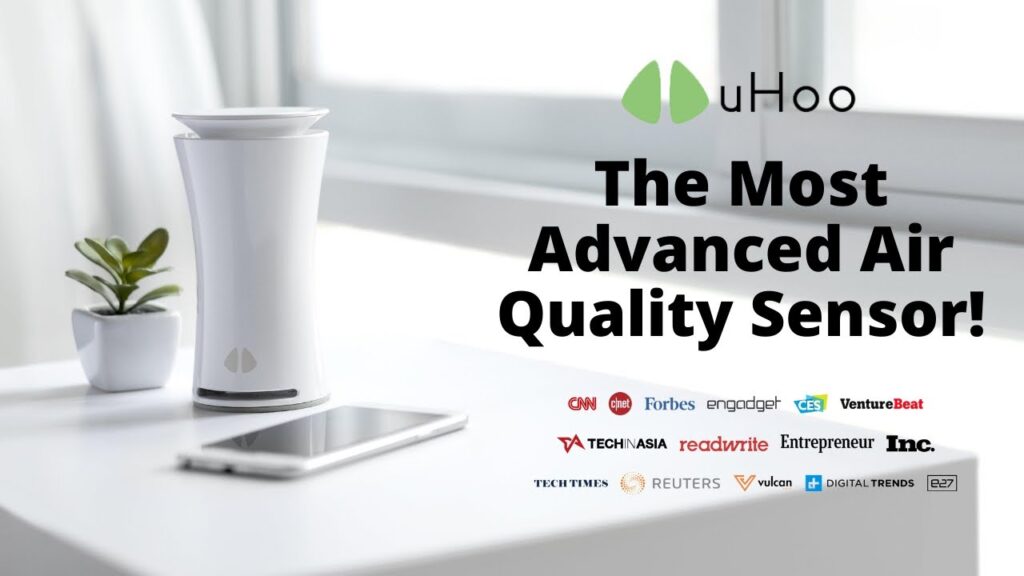
The uHoo Smart Air Monitor is touted as “the most advanced indoor air quality monitor” for good reason – it packs a whopping 9 different sensors into a sleek cylinder. From common metrics like PM2.5 and CO₂ to more specialized ones like carbon monoxide (CO), ozone (O₃), and nitrogen dioxide (NO₂), uHoo covers virtually the full spectrum of indoor pollutants. This device connects via Wi-Fi to deliver real-time alerts to your phone and even provides a unique “Virus Index” to gauge how conducive your air is to viruses (by analyzing temperature, humidity, and pollutant levels). With no display on the unit, uHoo is entirely app-driven. The companion app offers detailed insights and tips, while integrations with Alexa, Google Assistant, and IFTTT allow uHoo to trigger other smart devices (like HVAC or purifiers) for automated air management. For tech-savvy users or small offices that want laboratory-like readings at home, uHoo is a powerful prosumer-grade choice.
Pros:
- Unparalleled sensor range: Measures 9 key factors: temperature, humidity, PM2.5, CO₂, VOCs, CO, NO₂, O₃, and air pressure. It’s the only home monitor in this class capturing certain gases like nitrogen dioxide (traffic pollution) and ozone (a component of smog).
- High sensitivity: Reviewers praise its sensitivity and accuracy in detecting changestechhive.com. It uses NDIR for CO₂ and electrochemical sensors for gases, providing precise data for serious IAQ analysis.
- Rich app insights: The uHoo app provides real-time readings, trend graphs, and health recommendations. Notably, it includes a Virus Index and Mold Index, translating raw data into actionable alerts (e.g. warning when conditions favor virus survival or mold growth).
- Smart integrations: Supports Google Home, Amazon Alexa, and IFTTT, enabling voice queries (“Alexa, what’s my air quality?”) and home automation. For example, you can have uHoo turn on an exhaust fan if VOCs get high.
- Compact design: The device is small, discreet, and silent (no built-in fan noise). It blends into home or office decor like a minimalist gadget (just a single status LED), making continuous monitoring non-intrusive.
Cons:
- No onboard display: You must use the app or connected services to see readings – there’s no screen on the device itself. This can be less convenient for quick glances or for less tech-comfortable users.
- Subscription for full features: While basic monitoring is free, advanced features (like deeper analysis or integrations) may require uHoo Premium (a paid subscription). This adds to long-term cost for power users.
- App and interface quirks: Earlier versions of the app were criticized for being unintuitivetechhive.com. Although uHoo has improved its software, some users still find the app overwhelming or occasionally buggy. TechHive noted the device’s great sensor capabilities were undermined by a “poor app and smart home support” in early daystechhive.com (integration options have since expanded).
- Limited support network: uHoo is a smaller company, and warranty coverage is standard 1 year. While the community of users is growing, it doesn’t have the decades-long track record of larger brands, which may concern some buyers in terms of long-term support.
- Pricey upfront: At around $299 retail, it’s an expensive investment. You’re paying for breadth of sensors; however, if you don’t need exotic metrics like ozone or NO₂ regularly, you might not fully utilize all that you’re paying for.
Ideal Use-Case: Enthusiasts and small businesses that need comprehensive air data – e.g. an allergy sufferer tracking every possible trigger, or a small office/clinic ensuring a healthy environment. It’s perfect for those who want near lab-grade monitoring at home and are comfortable using smartphone apps and automation routines to manage their air quality.
Scorecard: (Total 48/60)
- Sensor Breadth & Accuracy: 10/10 – Industry-leading 9 sensors cover almost every IAQ parameter. High-quality sensor components (NDIR, electrochemical) yield reliable accuracy, though some rare gas readings (O₃/NO₂) may drift without regular recalibration.
- Certifications & Compliance: 8/10 – Meets all basic safety (FCC, CE) and wireless certifications. Not specifically WELL or LEED certified, but its metrics align with what those standards require (CO₂, etc.). The brand actively provides documentation for WELL building standard credits using uHoo data.
- Smart Features & Dashboard: 8/10 – Feature-rich app with unique indices (Virus/Mold) and alerts. Integrations now include Alexa, Google, IFTTT. Loses points for lacking a physical display and for prior app UX issues (though steadily improving).
- Deployment & Integration: 8/10 – Setup is straightforward (Wi-Fi 2.4 GHz). However, it must stay plugged in (no battery option) and relies on cloud for remote access. On the plus side, it’s easily tucked away and connects with many smart home platforms for automation.
- Support & Reliability: 7/10 – 1-year warranty is average. The company provides frequent firmware/app updates and has an active online support center, but as a newer player, it doesn’t have the established support infrastructure of larger brands. Some users have reported sensor calibration periods and occasional need to restart the device/app.
- Value for Consumer Users: 7/10 – It’s expensive and only worth it if you truly need the full suite of sensors. For those who do (for example, monitoring a home with indoor combustion, potential chemical off-gassing, and outdoor pollution intrusion), the value is there. For more typical home needs (just CO₂, PM2.5, etc.), more affordable monitors might offer better bang for buck.
🥉 Awair Element – Stylish Smart Monitor with Trusted Core Sensors (45/60)
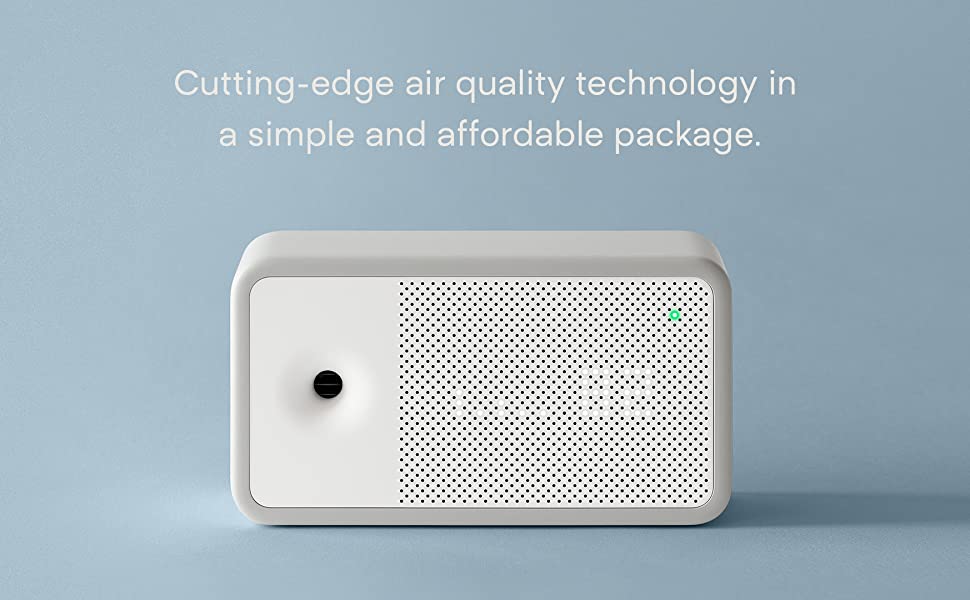
The Awair Element is a popular design-forward IAQ monitor that tracks the five key factors of healthy indoor air: PM2.5, CO₂, VOCs, temperature, and humidity. Housed in a sleek white case with a subtle LED matrix display, the Element seamlessly blends into modern homes while quietly keeping tabs on your air. It connects via Wi-Fi to the Awair Home app, where you can view detailed historical trends and get personalized tips to improve air quality. Awair is known for an intuitive app experience and an Awair Score (0–100) that simplifies complex readings into an easy-to-understand air quality index. The Element also shines in smart home integration – with Alexa, Google Assistant, and IFTTT compatibility, you can set up routines like turning on an air purifier when the Awair detects high dust or CO₂. While it doesn’t measure some less common pollutants, the Awair Element focuses on the most relevant ones for homes and does so accurately, making it a solid choice for everyday IAQ monitoring in style.
Pros:
- Key pollutant coverage: Measures the core IAQ metrics that impact daily comfort and health – fine particulates (PM2.5), carbon dioxide, and VOCs – in addition to temperature & humidity. These cover issues like dust/smoke, ventilation, and chemical off-gassing effectively.
- Minimalist design & display: The mid-century modern aesthetic (clean white/gray chassis) and an LED dot display make Element as much decor as gadget. The display subtly shows the Awair air quality score or specific readings, adjustable via the app. It’s a device you can put in the living room without it screaming “sensor.”
- Excellent app & insights: The Awair app provides real-time readings and continuous logging with attractive graphs. It also gives actionable feedback – e.g. if VOC levels rise, the app might suggest “Ventilate the room or check for chemical sources.” This guidance helps users actively improve their air.
- Smart home automation: Built-in integrations allow the Element to work with Amazon Alexa, Google Assistant, and IFTTT out of the box. For example, you can ask “Hey Google, what’s my Awair score?” or have a SmartThings fan turn on when CO₂ is high. Awair also provides an API and local network support, which tech enthusiasts have used in Home Assistant and other DIY setups.
- Responsive support & updates: Awair has a good track record of app improvements and customer support. Firmware updates have added features (like refining the VOC algorithm). The device is CARB (California Air Resources Board) certified and ETL/FCC certified for safety, reflecting a level of quality and compliance.
Cons:
- No particulate size range or extras: The Element detects PM2.5 but does not separately measure PM10 or ultrafine particles. It also lacks any formaldehyde-specific sensor or specialty gas sensors (no CO, NO₂, etc.). It covers the basics, but more advanced monitors offer broader sensing.
- No radon detection: Unlike some competitors (e.g. Airthings View Plus), the Awair Element cannot detect radon. Users in high-radon regions will need a separate radon detector if that’s a concern.
- Cloud dependence: The Element is Wi-Fi only (no Bluetooth except for initial setup) and heavily cloud-centric. If your internet goes down, you lose remote access and historical logging during that period. There is a local API mode, but it’s not officially documented for average users.
- Past cloud service concerns: Awair previously discontinued support for older devices in a way that left them non-functional without cloud access, which caused some distrust among early adopters. The Element is a newer model with active support, but long-term viability (beyond its 1-year warranty) relies on Awair’s continued cloud service.
- Limited on-device controls: Aside from a quick glance at the LED display, all configuration must be done through the app – there are no buttons or on-device menus. This isn’t unusual, but it means any smartphone downtime leaves you without a way to interact with the device.
Ideal Use-Case: Apartment dwellers and homeowners who want a stylish, plug-and-play monitor for the primary air quality indicators. It’s great for those who value a smooth app experience and plan to integrate air quality data into their smart home routines (e.g. automation with purifiers, HVAC, or alerts).
Scorecard: (Total 45/60)
- Sensor Breadth & Accuracy: 8/10 – Covers 5 essential parameters with reliable accuracy (NDIR CO₂, laser PM sensor, etc.). It omits some pollutants (no CO, NO₂, etc.), focusing on the common ones; what it does measure, it measures well.
- Certifications & Compliance: 7/10 – ETL and FCC certified, and CARB compliant for electrical safety and quality. While not a “professional” device, it has been used to help meet WELL building and RESET Air standards on projects, but it lacks formal lab calibration certificates.
- Smart Features & Dashboard: 9/10 – Top-notch app with historical data and personalized tips. Extensive smart home integration (Alexa, Google, IFTTT) is a big plus. The only thing missing is a web dashboard; app-only access could be a limitation for some.
- Deployment & Integration: 8/10 – Quick Wi-Fi setup and it stays out of your way. Needs AC power (no battery) and constant Wi-Fi. Integrates locally with some effort (API) and easily via cloud services. Loses a couple points for being offline-dependent.
- Support & Reliability: 6/10 – Awair offers standard 1-year warranty and responsive support. However, the prior shutdown of an older Awair product’s servers raises some caution. Current reliability is solid, but long-term support is a slight question mark.
- Value for Consumer Users: 7/10 – Originally around $200–$250, it’s a mid-range value. You get a polished product and app for the price, though purely in terms of sensors-per-dollar, some newer entrants (or DIY solutions) can beat it. For many users, the ease-of-use and design justify the cost.
4️⃣ IQAir AirVisual Pro – Pro-Grade Accuracy with Indoor/Outdoor Comparison (42/60)
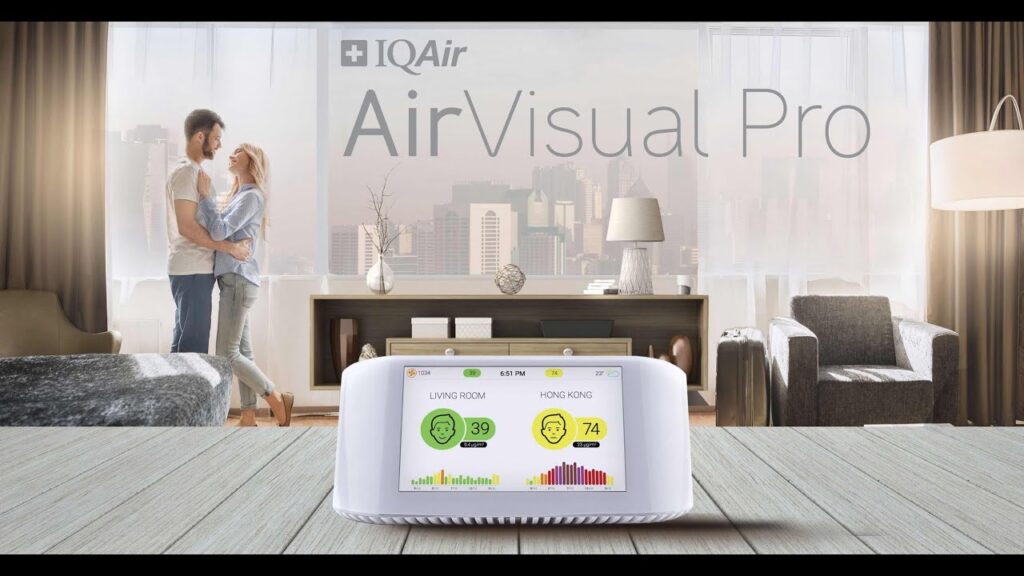
The AirVisual Pro by IQAir has earned a reputation as a reliable, science-backed IAQ monitor, especially beloved by air quality enthusiasts. This unit tracks PM2.5 and CO₂ levels with high precision, along with temperature and humidity. While it monitors fewer parameters than some competitors, it excels in those it does – for instance, its laser particle sensor provides extremely accurate PM2.5 readings (IQAir is an air purification company known for excellence in particulate filtration and measurement). A standout feature of the AirVisual Pro is its ability to show outdoor air quality alongside indoor readings: via Wi-Fi it can pull data from the nearest official station or an AirVisual outdoor sensor, so you can compare your indoor air vs. outside at a glance. The device features a bright 5″ color HD display that is easy to read, and it’s one of the rare monitors that includes a built-in battery, making it semi-portable for spot checks around your space. The AirVisual Pro syncs with a mobile app and web platform where data is logged and can be accessed remotely. It even has an open API and has been integrated into systems like Home Assistant. Overall, the AirVisual Pro is a focused tool: it provides professional-level accuracy for CO₂ and PM2.5, helping users make informed decisions about ventilation and air cleaning in real time.
Pros:
- High accuracy PM2.5 & CO₂: In independent tests and consumer reviews, the AirVisual Pro consistently scores top marks for accuracy. It uses a laser optical sensor for particulate matter and a robust NDIR sensor for CO₂. This focus makes it very trustworthy for monitoring wildfire smoke, urban pollution, or indoor CO₂ buildup from occupancy.
- Indoor/outdoor air comparison: The device can be configured to display your indoor readings side-by-side with outdoor air quality index (AQI) and pollutant levels (fetched from IQAir’s global network or a specific station). This is incredibly useful – you immediately see if opening a window will improve or worsen indoor air.
- Great display and interface: The 5″ HD screen is colorful and informative, showing graphs, current values, and AQI color codes. You can swipe through different screens (hourly trend, daily, etc.). It’s one of the more engaging standalone displays among IAQ monitors.
- Data connectivity: Wi-Fi enabled, the AirVisual Pro uploads data to the cloud for access via the AirVisual app or website. You can download your data history and even integrate via API into third-party services. (It’s supported in Home Assistant and other smart home platforms thanks to its open API.) Additionally, IQAir provides an Alexa Skill, allowing voice queries for your AirVisual readings.
- Portable battery operation: It has an internal rechargeable battery lasting a few hours, so you can carry it around to spot-check different rooms or use it briefly away from an outlet. This portability also makes it easy for contractors or consultants doing short-term assessments in multiple areas.
Cons:
- Limited pollutant types: The AirVisual Pro only measures four things: PM2.5, CO₂, temp, and humidity. It does not detect VOCs, formaldehyde, radon, or other gases. For comprehensive IAQ evaluation, you’d need additional sensors (IQAir chose to specialize in the most critical particles and CO₂).
- Higher cost: Priced around $269–$299, it’s an investment considering its narrower scope. You’re paying for accuracy and build quality rather than sheer number of features. Budget-conscious users might find monitors that cover more metrics for the same price, albeit with some accuracy trade-offs.
- No dedicated app alerts: The AirVisual app is primarily for data viewing; it doesn’t push as many proactive air quality tips or notifications as some others. It relies on you to interpret the data (though the color-coded AQI helps). In other words, it’s a bit more of an enthusiast’s tool.
- Older hardware: The model has been on the market for several years without a major update. While still effective, its Wi-Fi is 2.4 GHz only and some interface elements (touchscreen responsiveness, etc.) feel a tad dated. There have been occasional reports of Wi-Fi connectivity issues after many months of use (usually resolved by firmware updates or reconfiguring).
- No VOC or odor tracking: Situations like high chemical odors or cooking fumes (which are VOC-based issues) won’t be captured by this device. Users who want a “smell” sensor or general indoor chemical indicator would need an additional monitor for VOCs.
Ideal Use-Case: Serious IAQ analysts, schools, or small offices that primarily need to track CO₂ for ventilation and PM2.5 for air pollution. It’s perfect for someone who wants accurate numerical data and perhaps to participate in citizen science (contributing to AirVisual’s public map). Also great for comparing indoor vs outdoor conditions – e.g. during wildfire season or heavy pollution days, to decide when to run purifiers or open windows.
Scorecard: (Total 42/60)
- Sensor Breadth & Accuracy: 7/10 – Focused on quality over quantity. It nails CO₂ and PM2.5 accuracy (near reference-grade), but it’s missing VOC, CO, and other sensors. So breadth is limited, though accuracy is a strong suit.
- Certifications & Compliance: 6/10 – Device is CE/FCC compliant and developed by IQAir (a highly reputable company in air quality). No specific third-party accuracy certifications, but AQ-SPEC (South Coast AQMD) has tested similar sensors favorably. Not WELL certified, but it measures two WELL-required parameters (PM2.5 and CO₂) with enough reliability to use in those contexts.
- Smart Features & Dashboard: 8/10 – Excellent display and decent app. The ability to compare with outdoor data and an open API are big pluses. It has Alexa integration and is Home Assistant compatible. Missing are things like VOC alerts or a more advice-oriented app experience (it assumes you know what to do with the data).
- Deployment & Integration: 7/10 – Setup is straightforward; device can run on battery or AC. It’s not tiny, but still desk-friendly. Integration into third-party systems is possible (through API) but not as plug-and-play as some (no direct IFTTT triggers, etc. without using API). Wi-Fi only (no Bluetooth).
- Support & Reliability: 8/10 – Backed by IQAir’s customer support (generally very good). The hardware is solid and long-lasting. Firmware updates are infrequent but the platform has been stable. Community support is strong as many enthusiasts share tips. Warranty is 1 year standard.
- Value for Consumer Users: 6/10 – For a casual user, paying nearly $300 for only PM2.5 and CO₂ monitoring might seem steep, especially when some $150 monitors now include those plus VOC. However, for those who prioritize accuracy in those two critical metrics and appreciate the polished display and data quality, the value is there. It’s a specialized tool that is worth it for its target users but not an all-in-one bargain.
5️⃣ Qingping Air Monitor (QP Pro)** – Budget-Friendly 5-in-1 with Premium Performance (45/60)
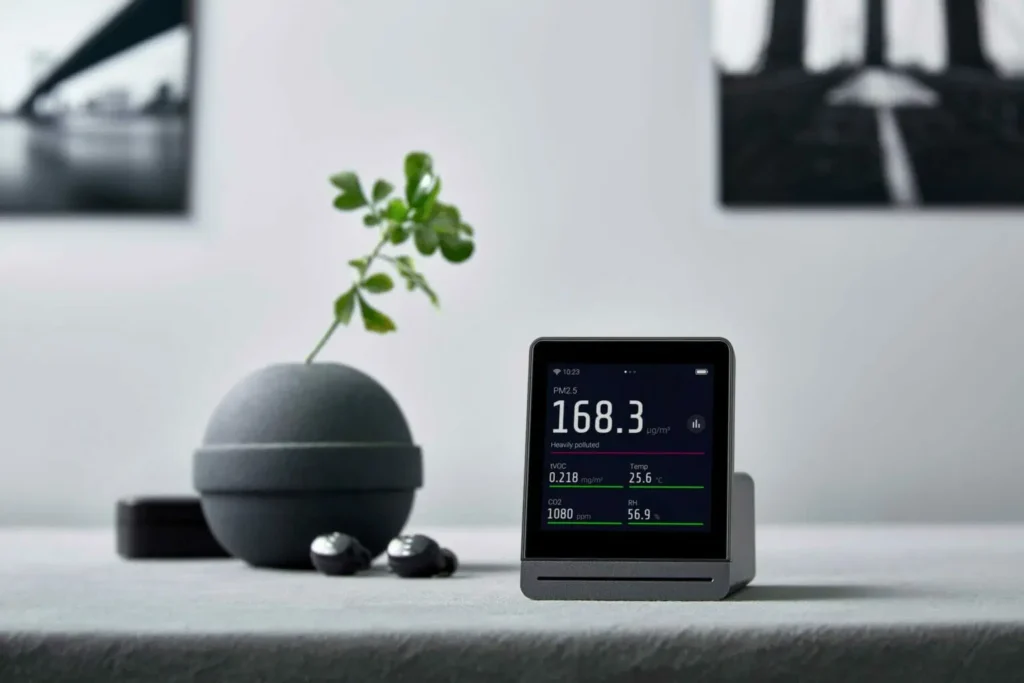
Relative newcomer Qingping has disrupted the home IAQ scene with its Air Monitor series, offering high-end specs at affordable prices. The Qingping Air Monitor Pro (QP Pro) is a 5-in-1 device tracking PM2.5, CO₂, TVOCs, temperature, and humidity, presented on a sharp 3.1″ color touchscreen. Remarkably, it achieves accuracy comparable to pricier monitors – Qingping uses quality components like a Sensirion SGP30 gas sensor and a well-calibrated NDIR CO₂ sensor, packaged in a clean, modern design. QP Pro features an intuitive interface: the touchscreen can display all readings at once or swipe through individual pollutant trendshousefresh.comhousefresh.com. It also includes a sound level meter and can function as an alarm clock, reflecting its all-around smart home positioning. With Wi-Fi connectivity, the Qingping+ app logs data and allows exporting of historical records. It even supports automation: currently you can link it with Xiaomi Home ecosystem devices, and Alexa/Google Assistant integration is planned via firmware update. Perhaps the biggest draw is value – at roughly $139, the QP Pro delivers capabilities (like a full-color display and data export) typically found in $250+ deviceshousefresh.com. It’s an ideal prosumer choice on a budget, though as a newer brand it doesn’t yet have the track record of the established players.
Pros:
- Great value, no compromise: You get a bright IPS display, touch controls, and precise sensors at a fraction of the cost of similar monitorshousefresh.com. HouseFresh’s testing found the QP Pro’s PM2.5 and CO₂ readings to be as good as premium models costing twice as much.
- CO₂, PM2.5 & VOC coverage: Hits the key trio for IAQ (airborne particles, carbon dioxide, and total VOCs). This covers common concerns like dust/smoke, ventilation, and chemical odors effectively. It also logs temperature and humidity for comfort monitoring.
- User-friendly interface: The touchscreen UI is very intuitive – you can see all metrics on one screen or dive deeper by swiping to see 24-hour trends for each pollutanthousefresh.comhousefresh.com. It’s as easy to use as a smartphone, with almost no learning curve. A small LED also changes color to give an at-a-glance air quality indicator (green/yellow/red).
- Portable with battery mode: The QP Pro has a built-in rechargeable battery (approx. 4-6 hours runtime). This means you can carry it around to check different rooms or use it temporarily in spaces without an outlet – flexibility often missing in budget monitors.
- Data logging and export: Unlike many low-cost devices, QP Pro allows you to download your data. The Qingping+ app stores readings (logged about every 15 minutes) and you can export them as CSV for analysis. This is fantastic for anyone who wants to crunch numbers or keep long-term records without subscription fees.
- Ongoing improvements: Qingping has been actively updating the device’s firmware. Promised features include direct Alexa/Google Home integration and additional smart home linkages. The company seems responsive to feedback, which is a good sign for future support.
Cons:
- Limited brand pedigree: Qingping isn’t yet a household name. It emerged from Xiaomi’s ecosystem, and while initial reviews are positive, some users report quality control variances (e.g., occasional screen issues or unit-to-unit sensor slight discrepancies). Buying from the “Qingping Store” on Amazon ensures warranty support, but it’s a newer brand so long-term durability is a bit unproven.
- Missing some sensors: It doesn’t measure PM10 (only PM2.5) and has no specialized sensors for things like formaldehyde, radon, or CO. Noise monitoring is included (doubles as a basic sound level meter), but that’s more a bonus feature. For most users this isn’t critical, but it’s not as all-encompassing as high-end models.
- App could be more robust: The Qingping+ app, while functional, is basic compared to competitors. It logs data and shows current values fine, but it lacks interpretive insights or advanced alert customization that others provide. Also, currently the smart home integrations (Alexa/Google) are still pending, which might frustrate users expecting full feature parity out of the box.
- Short battery life: The internal battery is convenient, but ~4 hours is only for temporary use. You’ll keep it plugged in for continuous monitoring (which is expected – the battery is mainly for portability, not 24/7 cordless use).
- No web dashboard: Data is accessible on your phone and exportable, but there’s no web portal for live monitoring on a PC. Also, without IFTTT or similar (yet), setting up automations might require creative workarounds until official support is added.
Ideal Use-Case: Budget-conscious buyers and tech enthusiasts who want advanced features without the high price. Great for someone who might otherwise consider a DIY monitor – QP Pro gives similar data accessibility and accuracy in a polished consumer device. It’s also suitable for small offices or classrooms needing multiple units; the low cost makes deploying several monitors feasible while still getting reliable readings of CO₂ and PM levels.
Scorecard: (Total 45/60)
- Sensor Breadth & Accuracy: 8/10 – Measures all the main categories (except specific gases like CO or NO₂). Accuracy is impressively high for CO₂ and PM2.5 given the price. VOC sensor gives general air cleanliness indication, though like all TVOC sensors it’s not selective. Overall a well-balanced set for typical IAQ monitoring.
- Certifications & Compliance: 5/10 – Carries basic FCC/CE marks for sale. No notable U.S. environmental or building standard certifications yet. Being a newer product, it hasn’t gone through third-party validations like UL or AHAM. This is an area where the established brands have an edge (hence the lower score here).
- Smart Features & Dashboard: 8/10 – Beautiful onboard UI and a functional mobile app. You can export data easily, which is a big plus for power users. However, until Alexa/Google integration is live, it lacks the voice/control features others have. No dedicated “tips” or health insights in app – it’s more numbers-driven.
- Deployment & Integration: 8/10 – Super easy setup and flexible placement (tabletop or wall-mount, USB-C power). The device even supports dual-band Wi-Fi (2.4/5 GHz), making connection hassle-free. Current integration is mainly via Qingping/Xiaomi app; broader smart home integration is expected but not fully here yet, keeping this from a higher score for now.
- Support & Reliability: 6/10 – Comes with product support via Amazon and likely a 1-year warranty (through Qingping or distributor) – fairly standard. The company is actively releasing firmware fixes, which is good. But being new, it hasn’t proven longevity. Some early adopters have noted minor bugs which were patched quickly. We’ll award a cautiously optimistic score here given the rapid improvements but also acknowledge the shorter track record.
- Value for Consumer Users: 10/10 – Outstanding value. At around $140, it competes with monitors 2–3× its price in capability. You’re essentially getting near pro-level performance (minus some niche pollutants) for a mass-market price. This high value proposition is where Qingping truly shines, making advanced IAQ monitoring accessible to more people.
Comparison Table – Key Features & Scores of Top 5 Monitors
| Rank | Monitor & Price (USD) | Key Sensors (Detected Pollutants) | Notable Features | Smart/Home Integration | Total Score (60) |
| 🥇 | Airthings View Plus – ~$299 | Radon, CO₂, PM2.5, VOCs, Temp, Humidity, Pressure | E-ink display; Battery-powered or USB; 5-year warrantyairthings.com | Alexa, Google, IFTTT (extensive)airthings.com | 56 |
| 🥈 | uHoo Smart Monitor – ~$299 | PM2.5, CO₂, CO, NO₂, O₃, VOCs, Temp, Humidity, Pressure | 9-in-1 sensors (most comprehensive); Virus & Mold index in app | Alexa, Google, IFTTT (cloud-driven) | 48 |
| 🥉 | Awair Element – ~$249 | PM2.5, CO₂, VOCs, Temp, Humidity | Sleek design; LED air quality display; Awair Score & tips | Alexa, Google, IFTTT (strong integration) | 45 |
| 4️⃣ | IQAir AirVisual Pro – ~$279 | PM2.5, CO₂, Temp, Humidity | 5″ HD color screen; compares indoor vs outdoor AQ; battery-enabled | Alexa skill, API (Home Assistant) | 42 |
| 5️⃣ | Qingping Air Monitor Pro – ~$139 | PM2.5, CO₂, TVOC, Temp, Humidity | 3.1″ Touchscreen display; data export; alarm clock & noise sensor | Xiaomi Home now; Alexa/Google coming | 45 |
Prices are approximate street prices in late 2025. “Key Sensors” list the main pollutants each device measures (all include basic temp/humidity).
🧭 Which IAQ Monitor Should You Choose?
Choosing the right indoor air quality monitor depends on which pollutants concern you most and how you plan to use the data. Here’s a quick guide:
- If you want the most complete picture of your air (and especially if radon is a concern): Go with the 🥇 Airthings View Plus. It’s the only pick that monitors radon – critical for many homeowners – on top of all other key IAQ metrics. The View Plus is an excellent all-around choice for comprehensive monitoring with minimal hassle, ideal for health-conscious families. You’ll get the broadest sensor suite and a very user-friendly package, though at a premium price.
- If you’re a data enthusiast or need lab-like detail: Consider 🥈 uHoo. It’s perfect for those who want to track every measurable aspect of air quality (from ozone to CO levels) and are comfortable diving into app data. uHoo shines in a scenario like monitoring an indoor workspace with possible chemical pollutants, or for users who like to tinker with smart home automation based on nuanced air quality changes. Just be prepared to use your smartphone often and possibly subscribe for advanced features.
- If you prioritize design and smart home integration on a moderate budget: 🥉 Awair Element is your best bet. It’s well-suited for living spaces or offices where you want the monitor to blend in aesthetically while still providing reliable alerts. Awair’s strength is its polished app and easy integration – great for tech-savvy users who might set up routines (for example, turning on an HVAC ventilator when CO₂ rises during a meeting). It doesn’t have exotic sensors, but it covers the everyday basics with style.
- If your focus is on CO₂ and PM2.5 accuracy (like ventilation and smoke concerns): The IQAir AirVisual Pro will serve you well. This is the choice for precise monitoring – for instance, a school classroom managing CO₂ levels for student alertness, or a homeowner during wildfire season checking that their indoor air stays clean. The AirVisual Pro also appeals to those who love having a standalone device with a rich display (no phone needed to interpret your data on the spot). It’s not the best for detecting odors or VOCs, but for particulate pollution and carbon dioxide, it’s rock solid.
- If you’re on a budget but don’t want to sacrifice key features: Qingping’s Air Monitor (QP Pro) offers incredible value. Choose this if you want lots of bang for your buck – say you want to outfit multiple rooms or a small office with monitors without spending a fortune. QP Pro is also a great pick for DIY-types or analysts who want access to their raw data; you can export and crunch numbers to your heart’s content. Keep in mind, since the brand is newer, you might not get the same long-term support as with Airthings or IQAir, but early feedback indicates it’s a quality device for the price.
In summary, match the monitor to your priorities: For an all-in-one solution with radon and a long track record, Airthings View Plus is top. For maximum sensor depth (including rarer gases), uHoo leads. Awair offers a balance of functionality and form, IQAir targets precision and insight, and Qingping delivers advanced monitoring at an entry-level price. Whichever you choose, any of these monitors will empower you to breathe easier by making the invisible qualities of your air visible – and that’s a smart step toward a healthier home or workspace. Enjoy cleaner air!
[1] [2] Airthings View Plus – Smart radon & air quality monitor
https://www.airthings.com/en/view-plus
[3] uHoo Smart Air Monitor review: Great sensor, but a bad app
https://www.techhive.com/article/815402/uhoo-smart-air-monitor-review.html