Top 5 Smart Thermostats with Building Automation Integration (2026 Review + Scores)
Independent Evaluation • Updated for 2026 • Commercial & Light-Commercial Focus
Commercial and light-commercial buildings – from offices and schools to retail stores and multifamily complexes – demand smarter HVAC controls than typical home thermostats. HVAC systems account for roughly 40% of a building’s energy usewbdg.org, so efficient, centralized control is critical. Unlike popular consumer smart thermostats (Nest, ecobee, etc.), commercial-grade units offer:
- Open BMS Protocols (BACnet, Modbus, KNX): Native integration into Building Management Systems via standard protocols for HVAC/lighting controloptigo.net.
- Advanced HVAC Control: Support for multi-stage RTUs, heat pumps, fan coil units, economizers, and custom sequences beyond simple home HVAC.
- Smart Sensors & IAQ: Built-in occupancy, humidity, and even CO₂ sensors to optimize comfort and save up to ~30% on HVAC energy via automationknxpoint.com.
- Enterprise Management: Remote multi-thermostat scheduling, central dashboards (cloud or on-premise), and user permission controls – often with no subscription fees.
- Rugged Reliability: Commercial thermostats are designed for 24/7 operation, with cleaner flat-touch designs for easy sanitation and long-term durability.
This guide ranks the Top 5 Smart Thermostats (2026 edition) that seamlessly integrate with building automation. We use transparent scoring across 7 weighted categories to evaluate each device’s integration, features, and value.
📊 Key Commercial HVAC Control Facts
✔️ HVAC = Biggest Energy User: Heating/cooling systems consume ~39% of commercial building energywbdg.org – the largest single share, making smart control a high-impact efficiency measure.
✔️ Automation Saves Energy: Studies show that advanced building automation (schedules, occupancy sensors, etc.) can cut HVAC energy use by ~30% on averageknxpoint.com, improving sustainability and operating costs.
🧠 Scoring Categories (0–10 per category, Weighted) – Total Score = 60 points
- Integration & Protocols: Support for BACnet (IP/MSTP), Modbus, KNX, and ease of BMS integration.
- HVAC Control & Flexibility: Versatility in handling various HVAC equipment (stages, fan speeds, economizers) and custom control logic.
- Smart Sensors & IAQ: Built-in sensors (occupancy, humidity, CO₂/VOC) and intelligent features for air quality and energy savings.
- User Interface & Management: Touchscreen usability, mobile app/cloud platform, multi-site management capabilities.
- Installation & Retrofit: Retrofit-friendliness (e.g. line-voltage support, wireless options), and ease of installation/configuration.
- Reliability & Support: Device build quality, firmware updates, cybersecurity, and manufacturer support for commercial deployments.
- Value for Commercial Use: Price relative to features, energy savings potential, and suitability for mid-market projects.
🥇 Top 5 Smart Thermostats (2026 Ranking Summary)
| Rank | System & Model | Score | Best For |
| #1 | Distech ECLYPSE ECY-STAT (Connected Thermostat) | 56/60 | Best Overall – Full BMS Integration (offices, campuses) |
| #2 | Honeywell TC500A-N (Commercial Connected Stat) | 53/60 | Best User-Friendly Cloud Option (retail chains, clinics) |
| #3 | Johnson Controls TEC3000 Series (Smart Stat) | 51/60 | Best Standalone/Network Hybrid (schools, retrofits) |
| #4 | Schneider SpaceLogic SE8000 Series (Room Controller) | 48/60 | Best Multi-Protocol Solution (hotels, mixed-use buildings) |
| #5 | ABB Tenton KNX Multifunction Sensor (3-in-1 Room Ctrl) | 46/60 | Best KNX Option (high-end offices, EU projects) |
🥇 #1: Distech ECLYPSE ECY-STAT – Best Overall BMS-Integrated Thermostat

Score: 56/60 | Ideal For: Office buildings, university campuses, healthcare facilities
⭐ Overview: The Distech ECY-STAT is a powerful “all-in-one” smart thermostat that doubles as a mini Building Automation controller. It features a modern touchscreen and built-in IP connectivity (Ethernet & Wi-Fi) for easy integration on IT networkscochranesupply.com. Unlike basic thermostats, the ECY-STAT is fully programmable: it comes with pre-loaded HVAC applications or can be custom-programmed via graphical tools to handle unique sequencescochranesupply.com. This flexibility makes it ideal for complex commercial HVAC setups – from multi-stage rooftop units to fan coil units with lighting and sunblind controlcochranesupply.com. An optional mobile app allows occupants to adjust settings via Bluetooth, and a web interface (ENVYSION) is built-in for remote management of smaller installationscochranesupply.com. In short, ECY-STAT provides enterprise-grade control and integration in a thermostat form factor.
🔧 Key Specs:
- Integration: BACnet/IP (wired or Wi-Fi) natively; Bluetooth Low Energy for occupant app; acts as a BACnet Building Controller on the network.
- HVAC Support: Up to 4 universal inputs, 5 digital outputs, 3 analog outputs – suitable for complex AHUs, heat pumps, 2-pipe/4-pipe fan coils, etc. Fully programmable DDC logic for bespoke sequences.
- Smart Features: Embedded temperature & humidity sensors, plus support for add-on sensors. 7-day scheduling (single or dual setpoints) for standalone usecochranesupply.com. Occupancy can be programmatically used for set-back. Supports controlling lighting and blinds via BACnet objects from the same devicecochranesupply.com.
- User Interface: 3.5” color touchscreen; also pairable with the myPersonify mobile app (Bluetooth) for local controlcochranesupply.com. The screen can display custom graphics, and even the building’s logo or messages.
- Installation: Powered by 24VAC; mounts like a standard thermostat. Wired Ethernet or Wi-Fi connectivity simplifies retrofits (no new BACnet MS/TP wiring needed). Supports daisy-chaining devices over IP.
- Extras: Built-in web server for configuration and monitoring; can run small building dashboards. Fully BTL-listed for BACnet compliance.
🧪 Scoring Breakdown:
- Integration & Protocols: 10/10 – Supports BACnet/IP out-of-the-box (and MSTP via gateway if needed). Acts as a native BACnet controller for seamless BMS integration.
- HVAC Control & Flexibility: 10/10 – Highly programmable control sequencescochranesupply.com, extensive I/O for various equipment, making it as flexible as a small AHU controller.
- Smart Sensors & IAQ: 8/10 – Internal temp/humidity; lacks built-in motion or CO₂, but can integrate external sensors via inputs or BLE.
- User Interface & Management: 9/10 – Attractive touchscreen and mobile appcochranesupply.com. Web interface for multi-unit management is a plus. Slight learning curve for custom programming.
- Installation & Retrofit: 8/10 – Larger footprint than simple stats, but replacing a wall stat is straightforward. Wi-Fi connectivity eases retrofits, though secure IT setup is needed.
- Reliability & Support: 9/10 – Solid-state design; backed by Distech (Acuity). Regular firmware updates and strong integrator community support.
- Value for Commercial: 10/10 – High upfront cost (often $500+ each) but eliminates need for separate controllers – a cost-effective solution for advanced control in mid-sized buildings. Energy savings and flexibility justify the investment.
👍 Pros:
- Ultimate Flexibility: Essentially a mini-BAS controller with thermostat simplicity – customize any sequence or integrationcochranesupply.com.
- IP & Wi-Fi Enabled: No RS-485 wiring needed; connects via Ethernet/Wi-Fi to BACnet/IP networkscochranesupply.com. Great for modern IP-based buildings.
- Mobile & Web Apps: Bluetooth commissioning and occupant control app for ease; onboard web pages for small system management.
- Multi-System Control: One device can manage HVAC and send commands for lights/blinds – reducing wall cluttercochranesupply.com.
👎 Cons:
- Requires Programming for Custom Use: Out-of-the-box profiles cover common setups, but advanced use needs a controls technician (learning EC-gfxProgram).
- Higher Cost: Significantly pricier than simpler stats (enterprise-grade pricing). Might be overkill for very small/simple sites.
- No Native KNX/Modbus: Focused on BACnet/IP; lacks direct Modbus or KNX support (could use gateway if needed).
🏁 Bottom Line: The Distech ECLYPSE ECY-STAT is the gold standard if you need a smart thermostat that truly integrates into a building automation system. It combines the brains of a programmable controller with the looks and convenience of a modern thermostat. For complex commercial projects or campuses aiming for maximum efficiency and integration, ECY-STAT delivers exceptional capability and long-term value.
🥈 #2: Honeywell TC500A-N – Best User-Friendly Cloud-Connected Stat
Score: 53/60 | Ideal For: Retail chains, clinics, restaurants, small offices
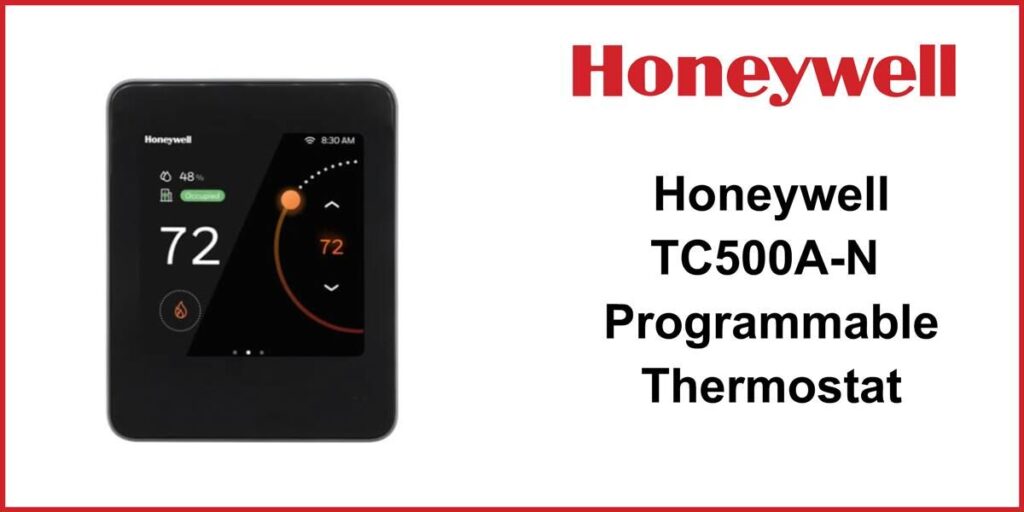
⭐ Overview: Honeywell’s TC500A-N is a sleek, next-generation commercial thermostat designed to be installer-friendly and end-user friendly. It sports a glossy touchscreen interface (replacing Honeywell’s older T7350 series) and packs enterprise features in an approachable package. Out of the box, the TC500A supports advanced HVAC control sequences (up to 5H/3C heat pump or 3H/3C conventional systems)kele.comkele.com – meaning it can handle multistage units, modulating outputs, and even economizer control for rooftop units. Integration is a strong suit: it communicates via BACnet/IP (over Wi-Fi) and even BACnet MS/TP (after a firmware update)cochranesupply.comcochranesupply.com, so it can tie into legacy BAS networks. The thermostat also includes Wi-Fi and Bluetooth connectivity, allowing setup and control through Honeywell’s smartphone apps. An on-board occupancy sensor and humidity sensor enable smart setbacks and demand-controlled ventilation. Honeywell’s cloud portal lets facility managers oversee multiple TC500s across sites – a big plus for light commercial portfolios. Overall, the TC500A-N strikes a balance between sophisticated capabilities and ease of use, backed by a familiar brand.
🔧 Key Specs:
- Integration: BACnet MS/TP and IP over Wi-Fi (dual capability) for BMScochranesupply.com. Also exposes data via Honeywell’s cloud. Supports Honeywell’s Sylk bus for add-on sensors. BTL certified for BACnet interoperability.
- HVAC Support: 3 heat/3 cool conventional or 5H/3C heat pumpkele.com plus modulating outputs for heat/cool. Handles multi-speed fan control and economizer (free cooling) logic. Suitable for packaged RTUs, AHUs, heat pumps, and fan coil units.
- Smart Features: Occupancy sensor built-in (for local motion detection) and a proximity sensor to wake the screenamazon.com. Supports advanced scheduling (up to 4 events/day including pre- and post-occupancy purges)amazon.com. Capable of open ADR for demand response participationzotsupply.comcochranesupply.com. Humidity control and dehumidification sequences are available. Cloud alerts and remote adjustments via Honeywell web/mobile interface.
- User Interface: 4″ full-color touchscreen with an intuitive, modern UI (flat glass for easy cleaning)amazon.com. Displays occupancy status, humidity %, and setpoints clearly. Configuration can be done on-screen or via the Honeywell Connect Mobile app (Bluetooth). Multi-site management through Honeywell’s Small and Medium Building Administrator cloud platformcochranesupply.com.
- Installation: Standard 24VAC power and wiring (supports up to 2 universal inputs and 2 configurable outputs for aux devices)cochranesupply.com. Connects to Wi-Fi for cloud/BAS – no ethernet port needed. RS-485 terminals for BACnet MSTP or Modbus (the device literature indicates Modbus RTU capability via RS-485 as well)cochranesupply.com. Firmware updates can be pushed OTA via Wi-Fi.
- Extras: Multi-level user access control (lockouts, setpoint limits) for tamper-proof operation in public areascochranesupply.com. Built-in demand limit mode for utility peak shaving. Compatible with a wide range of existing Honeywell remote sensors (20k NTC, etc.), easing retrofit of older statsamazon.com.
🧪 Scoring Breakdown:
- Integration & Protocols: 9/10 – Dual BACnet (IP over Wi-Fi, and MSTP) ensures compatibility with almost any BAScochranesupply.com. No native KNX, but covers North American standards. Cloud API integration possible via Honeywell.
- HVAC Control & Flexibility: 9/10 – Handles complex HVAC sequences (stages + modulating, econ, aux heat) out of the boxkele.com. Limited custom logic compared to fully programmable units, but meets most use cases.
- Smart Sensors & IAQ: 8/10 – Built-in temp, RH, occupancy sensorsamazon.com. Lacks CO₂ sensing (requires external sensor via input if needed). Occupancy-based control and scheduling are strong.
- User Interface & Management: 10/10 – Polished touchscreen that’s easy to navigate; remote management via app/cloud is a big plus for multi-site usecochranesupply.com. End-users appreciate the modern look and simple controls.
- Installation & Retrofit: 9/10 – Designed as a drop-in upgrade for older Honeywell commercial stats (even uses similar subbase footprint). Wi-Fi means no new comm wires if using BACnet/IP. Slight extra effort to join Wi-Fi securely.
- Reliability & Support: 8/10 – Backed by Honeywell’s support network. Regular firmware improvements (e.g. MSTP added via update)cochranesupply.com. As a newer product, long-term field data is still growing, but initial feedback is positive.
- Value for Commercial: 10/10 – Mid-range pricing (~$600 listkele.com, often less street) for a feature-packed stat. Delivers enterprise capabilities (cloud+BAS integration) at a cost far below full BAS controllers. Quick energy wins from scheduling and occupancy justify its cost.
👍 Pros:
- Easy Multi-Site Management: Honeywell’s cloud platform allows facility managers to oversee and tweak multiple thermostats remotely – great for retail or branch offices.
- Full HVAC Capability: Handles advanced sequences (stages, modulating, economizers) without custom programmingkele.com. Ideal for light commercial units with varied needs.
- Sleek Touch UI: Modern touchscreen is intuitive and easier to sanitize than older button statsamazon.com. Occupants get a premium feel (comparable to high-end residential stats).
- Dual Network Options: Both Wi-Fi (BACnet/IP) and wired BACnet MS/TP give flexibility for new or legacy integrationcochranesupply.com. Bluetooth commissioning makes installer’s job faster.
- Occupancy & Schedules: Smart scheduling with occupancy overrides yields significant energy savings and can meet ASHRAE healthy building recommendationsamazon.com.
👎 Cons:
- Cloud Dependency for Some Features: While BAS integration works locally, advanced multi-site analytics and alerts rely on Honeywell’s cloud service (which, though currently free, is internet-dependent).
- No Native KNX/Modbus (out-of-box): Modbus RTU may be possible via RS-485, but primarily it’s a BACnet and Wi-Fi device. KNX users would need a gateway.
- Mid-Level Customization: Not programmable like a DDC controller – you are limited to the configuration options provided (albeit extensive). Complex bespoke sequences might require a different solution.
- Availability/Discontinuation: Honeywell lists the TC500A as discontinued on some sites (likely replaced by a newer model)buildings.honeywell.com, so ensure you get the latest firmware or successor model (if any).
🏁 Bottom Line: The Honeywell TC500A-N brings smart thermostat tech into the commercial arena with a focus on ease-of-use and robust integration. It’s the ideal choice for organizations that want to quickly upgrade from dumb thermostats to a connected, energy-saving solution without diving into full-blown BAS programming. From small commercial buildings to franchise chains, the TC500A offers a sweet spot of functionality and simplicity – all while speaking the language of building automation (BACnet). It’s a “no brainer” upgrade to save energy and modernize climate control in 2026.
🥉 #3: Johnson Controls TEC3000 Series – Best Standalone/Networked Hybrid Thermostat
Score: 51/60 | Ideal For: Schools, office retrofits, any building upgrading from pneumatic or older electronic stats
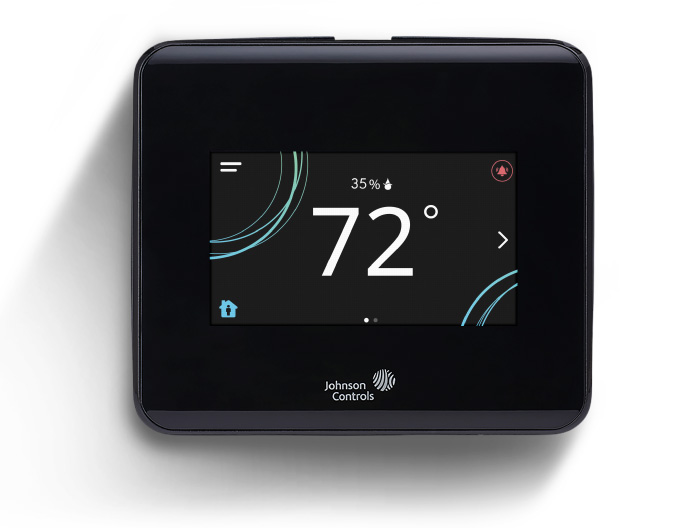
⭐ Overview: Johnson Controls’ TEC3000 series represents a family of networkable thermostats that can operate standalone or as part of a BAS. It’s a direct evolution of JCI’s well-known programmable stats, now with a full-color touchscreen and models offering wired or wireless networking. Uniquely, every TEC3000 is field-selectable for BACnet MS/TP or legacy N2 protocoljohnsoncontrols.com – making it a drop-in upgrade for both modern BAS and older JCI Metasys systems without hardware changes. These thermostats are tailored to common equipment like 2-pipe/4-pipe fan coil units, VAVs, rooftop units (with or without economizer), and heat pumpsjohnsoncontrols.comjohnsoncontrols.com. The TEC3000 emphasizes ventilation and indoor-air-quality features: newer firmware adds an “epidemic flush” mode to purge buildings with fresh air (following COVID guidelines)johnsoncontrols.com, demand-controlled ventilation with CO₂ sensor integrationjohnsoncontrols.com, and occupancy sensing to trim ventilation when areas are emptyjohnsoncontrols.com. Some models come with a built-in PIR motion sensor to enable these savings, reportedly achieving up to 30% energy savings in hotels and schools by automatically set-back in unoccupied periodsjohnsoncontrols.com. The interface is straightforward, displaying plain-text status and an adjustable brightness screenjohnsoncontrols.com. With USB stick cloning for rapid setup of multiples, the TEC3000 shines in retrofit deployments where simplicity and reliability are key.
🔧 Key Specs:
- Integration: BACnet MS/TP (RS-485) or JCI N2 bus selectable per devicejohnsoncontrols.com. This is a huge benefit for replacing old stats on N2 networks or migrating to BACnet later without swapping hardware. Some models also support wireless (ZigBee) network connectivity to JCI’s Verasys system (optional models with “-WR” have wireless capability).
- HVAC Support: Multiple model variants cover single-stage, multi-stage, and modulating applications. For example, TEC3610 for multi-stage RTUs, TEC3620/3630 for fan coils, etc. Most support up to 2 stages heat/2 cool + economizer, or proportional 0-10V outputs for valve control. Also can control fan speeds (on/off, multi-speed, or 0-10V EC fans) and auxiliary reheat. Ventilation control features (via CO₂ sensor or schedules) are integrated.
- Smart Features: Built-in occupancy sensor on many models (indicated by “-00-000” vs “-16-000” in model number) for auto occupied/unoccupied modejohnsoncontrols.com. Supports scheduled fan circulation to periodically mix air, and dehumidification control (e.g., enabling cooling + reheat if humidity is high)johnsoncontrols.com. When paired with wireless CO₂ sensors, can do demand-controlled ventilation (DCV). The “epidemic mode” flush can override settings to maximize outside air intake per CDC/ASHRAE recommendationsjohnsoncontrols.com. Each unit stores schedules locally (7-day programmable).
- User Interface: 4.2″ color LCD touchscreen with simple menu-driven settingsjohnsoncontrols.comjohnsoncontrols.com. The UI focuses on clarity over flash – it shows temperature, humidity, and mode in text/icons. An LED backlight brightens on touch. USB port on each unit allows cloning settings to another (great for deploying dozens quickly)johnsoncontrols.com. There is no mobile app (JCI favors using either the BAS or the on-device interface for config).
- Installation: Standard 24VAC; uses either 2-wire comm for BACnet/N2 or optional wireless. Form factor is somewhat larger than a typical home stat, but it covers old stat footprints. Screw terminal wiring. Upgradable firmware via the USB port if needed. Option to add a remote thermistor if you want to hide the stat or average temperature.
- Extras: Security features include setpoint limits, keypad lockouts. Energy reporting: When integrated to JCI software, it can log run-times, etc., but on its own it’s more of a real-time controller. BTL-listed for BACnet. Integrates seamlessly with JCI’s Metasys, Verasys, and Facility Explorer systems (plug-and-play points).
🧪 Scoring Breakdown:
- Integration & Protocols: 8/10 – BACnet MSTP is standard; no IP unless through a separate controller. N2 support is a unique plus for legacy sitesjohnsoncontrols.com. No direct Modbus/KNX support.
- HVAC Control & Flexibility: 8/10 – Good range of models for typical equipment. Not user-programmable, but covers 80+% of use cases (multiple sequences built-in). Ventilation and economizer logic is a standout. Lacks the freedom of fully custom logic, but simpler to deploy as a result.
- Smart Sensors & IAQ: 9/10 – Occupancy sensing, humidity control, CO₂-based ventilation – strong focus on IAQ and efficiencyjohnsoncontrols.comjohnsoncontrols.com. Lacks integrated CO₂ sensor (requires external), but that’s typical.
- User Interface & Management: 7/10 – Straightforward screen, but not as flashy as others. No dedicated remote app (integration with BAS for remote control instead). Cloning via USB is very installer-friendlyjohnsoncontrols.com. Could benefit from a web interface or simple PC tool for those not on JCI BAS.
- Installation & Retrofit: 10/10 – Specifically designed for retrofits: fits common wall holes, replaces both old electronic and pneumatic (with retrofit kits) stats. The ability to switch from N2 to BACnet later is a huge future-proofing itemjohnsoncontrols.com. Wireless models avoid running new comm wires in retrofits.
- Reliability & Support: 9/10 – JCI has decades of experience with these; they are generally rock-solid and last years. Widely deployed, so technicians are familiar. 5-year warranty typical. Only minor issue: ensure occupancy sensor window isn’t obstructed.
- Value for Commercial: 10/10 – Priced competitively (~$250–$400 depending on model/features), they deliver serious energy savings (JCI cites ~30% with occupancy)johnsoncontrols.com. Perfect for mid-market buildings that need better control without a huge BAS investment.
👍 Pros:
- Seamless Retrofits: Drop-in replacement for both old JCI network thermostats and standalones. Field-selectable BACnet/N2 means one SKU works in many scenariosjohnsoncontrols.com – great for phased BAS upgrades.
- IAQ and Energy Focus: Out-of-the-box features to flush buildings, vary ventilation by occupancy/CO₂, and manage humidity offer health and efficiency benefits for contemporary concernsjohnsoncontrols.comjohnsoncontrols.com.
- Occupancy Sensing: Models with PIR can automatically adjust setpoints and ventilation when rooms are empty, yielding substantial savings with zero user inputjohnsoncontrols.com. Perfect for classrooms, hotel rooms, etc.
- Robust and Simple: No internet or cloud needed; all logic runs locally for reliability. The interface is simple enough that facility staff can adjust it without training. USB cloning saves setup time on large jobs.
- Integration with JCI Ecosystem: If you have JCI’s BAS, these thermostats integrate and show up with advanced data (occupancy status, ventilation mode, etc.) in Metasys/FX/Verasys. Even without, they still work standalone.
👎 Cons:
- No Native IP Connectivity: They rely on MSTP (RS-485). In an IP-centric building, you’d need MSTP to IP routing via a controller. (JCI does offer a separate IP hub or you can use their Verasys IP system, but that’s extra hardware).
- Limited Eye Candy: The screen, while functional, is not as modern-looking as some competitors (it’s more utilitarian). In high-end spaces, some may prefer a more stylish aesthetic.
- No Dedicated Cloud/App: Unlike some others, JCI doesn’t provide a cloud dashboard specifically for TEC3000; remote access is through integrating with a BAS. For some smaller customers, that means no remote access unless they invest in additional systems.
- KNX or Wi-Fi not Supported: These are strictly BACnet/N2 devices. Anyone looking for KNX compatibility or direct Wi-Fi connectivity will need a different solution or additional gateway.
🏁 Bottom Line: Johnson Controls’ TEC3000 series hits the sweet spot for many commercial retrofits and upgrades: it’s sophisticated enough to improve HVAC control and indoor air quality, yet simple enough to install en masse and use daily. The dual-protocol design speaks to JCI’s understanding of real buildings – many are stuck with 20-year-old controls that these thermostats can replace in a snap. For schools, offices, or hospitals aiming to enhance comfort and efficiency (especially in a post-2020 world of ventilation awareness), the TEC3000 is a proven choice. It doesn’t have flashy cloud features, but it does have the features that matter on-site – and in a battle between marketing sizzle and reliable steak, JCI delivered the steak.
🏅 #4: Schneider Electric SpaceLogic SE8000 Series – Best Multi-Protocol & Retrofit Solution
Score: 48/60 | Ideal For: Hotels, multi-use buildings, any project requiring BACnet and Modbus integration
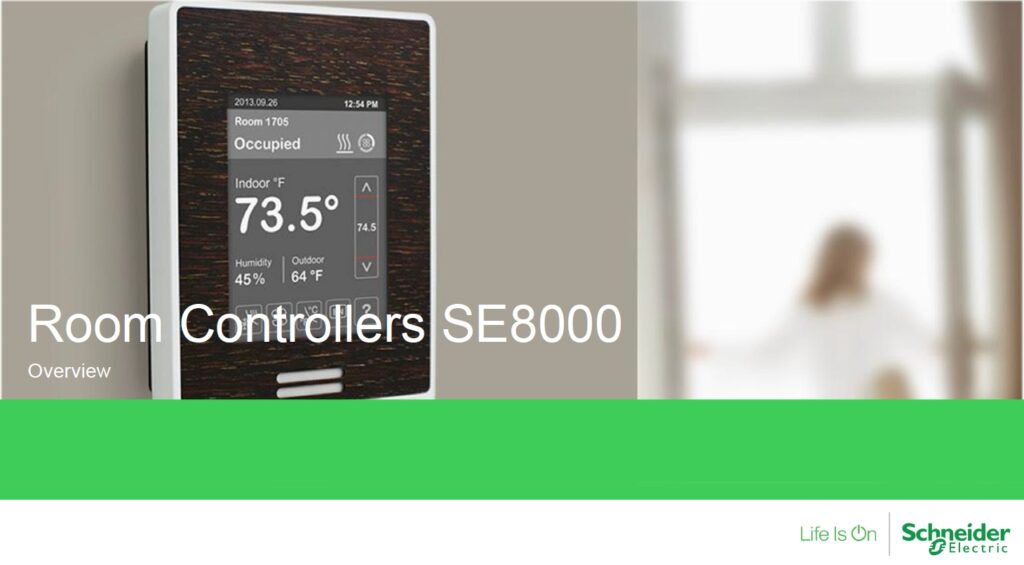
⭐ Overview: The SpaceLogic SE8000 series (formerly Viconics/Schneider SE8000) is a line of fully programmable room controllers that blur the line between thermostat and DDC controller. These devices feature a customizable touchscreen and are notable for supporting multiple communication protocols out-of-the-box: BACnet MS/TP, Modbus RTU, and optional Wi-Fi (BACnet/IP)assets.gordonelectricsupply.comassets.gordonelectricsupply.com. This flexibility makes them a top choice in buildings where different systems need to talk – for instance, integrating with a BACnet BMS while also interfacing with Modbus HVAC equipment. The SE8000 is especially popular in hospitality and high-end office applications due to its elegant design and flexibility. It can be tailored for fan coil units (2-pipe/4-pipe), heat pumps, VAV zones, and more. Each unit is scripting-programmable, allowing custom control sequences and even custom on-screen display graphics (like hotel logos or personalized messages)assets.gordonelectricsupply.comassets.gordonelectricsupply.com. A unique two-piece design (controller + optional relay pack) enables retrofitting line-voltage fan coil thermostats without running new wires or adding extra relaysassets.gordonelectricsupply.comassets.gordonelectricsupply.com – hugely simplifying upgrades in older buildings. The SE8000 can also integrate with wireless peripherals: add-on Zigbee modules allow it to receive data from wireless door/window contacts, motion sensors, and even water leak detectors for enhanced HVAC control and property protectionassets.gordonelectricsupply.comassets.gordonelectricsupply.com. With features like on-board humidity sensing and dehumidification controlassets.gordonelectricsupply.com, occupancy-based setpoints, and the ability to control lighting/blinds through the BAS, the SE8000 is a powerhouse for building automation integration.
🔧 Key Specs:
- Integration: Wired BACnet MS/TP or Modbus RTU (field-selectable) on every unitassets.gordonelectricsupply.com. Optional Wi-Fi module (VCM8000) adds BACnet/IP capability and even email alert functionalityassets.gordonelectricsupply.com. Supports add-on Zigbee Pro module for wireless integration into Schneider’s ecosystem or for multi-unit coordinationassets.gordonelectricsupply.com. Fully BTL-certified for BACnet. It’s basically vendor-agnostic – works with Schneider BMS or others alike.
- HVAC Support: Extremely versatile: configurable for 2-pipe or 4-pipe FCUs, with up to 3 fan speeds plus aux heatmedia.distributordatasolutions.comcochranesupply.com. Handles conventional RTUs, packaged units, and can be used for VAV zone control (SE8600 model for VAV with analog damper output). Onboard I/O typically includes 2 digital inputs (e.g., window switch, occupancy dry contact) and 5 outputs (relays/triacs for fan and valves) – plus additional combinations depending on model. Line-voltage option: The SER8300 model with SC3000 relay pack can switch 120/240V fan coil loads directlyassets.gordonelectricsupply.com. Fully programmable logic via scripting for custom sequences (e.g., controlling an exhaust fan based on humidity, etc.).
- Smart Features: Humidity sensor onboard, with integrated dehumidification sequences (can cycle cooling and reheat to maintain RH)hvacusa.com. Optional PIR motion sensor built-in on many models (denoted by trailing “5” in model number) for occupancy detectionassets.gordonelectricsupply.com. Advanced occupancy functions allow local logic: e.g., if door opens and no motion after X minutes, assume room unoccupied and set back tempassets.gordonelectricsupply.com. Can bind with wireless window/door contacts and motion sensors (Schneider offers battery Zigbee sensors) to further optimize HVAC – for example, shutting off HVAC if balcony door is left openassets.gordonelectricsupply.com. Supports wireless thermostat grouping (with Zigbee) to link multiple stats or connect to a central coordinator. Custom displays: Screen theme, language, and even logos/messages can be customized, which is great for branding in hotelsassets.gordonelectricsupply.com.
- User Interface: 3.5″ backlit color touchscreen. The UI can be skinned in various color themes to match décor. It shows room temp, setpoint, mode, fan speed, and icons for humidity/occupancy. Users can adjust temperature and fan with touch buttons. There’s a standby screen option where you can show a logo or info when idleassets.gordonelectricsupply.com. Note: The interface is quite configurable – installers can choose which buttons to expose to guests vs hide, etc. It’s not as high-res flashy as a phone, but highly functional and customizable.
- Installation: For low-voltage models, it’s 24VAC powered and wires like a typical thermostat/controller. The SER8300 line-voltage variant simplifies retrofits: you mount the stat and a relay pack (SC3000) near the fan-coil unit; it uses existing high-voltage wiring between them so you don’t need to run new control cablingassets.gordonelectricsupply.com. This means you can replace a old line-voltage thermostat controlling a 277V fan coil with an SER8300 without pulling new wires – a massive labor saver. Commissioning is done on-screen or via Schneider’s software (if integrated with their BMS). Wi-Fi setup for the IP module is usually via a PC tool or temp hotspot.
- Extras: Design options: Comes in white or silver casings, and various fascia styles (Schneider offers over 70 combinations of covers/trim to suit interior designers)docs.galco.comassets.gordonelectricsupply.com. Multi-lingual support on screen. Lighting and meter integration: Through BACnet, an SE8000 can send commands to other devices – e.g., turn lights on when occupied (if programmed), since it can publish occupancy status on the network. It essentially brings some BMS logic to the room level.
🧪 Scoring Breakdown:
- Integration & Protocols: 10/10 – Unmatched protocol flexibility: BACnet & Modbus in one deviceassets.gordonelectricsupply.com, plus optional KNX gateway if needed (not native, but many have interfaced via BACnet-KNX gateways). The Wi-Fi BACnet/IP option and Zigbee wireless sensors further show its integrator-friendly design.
- HVAC Control & Flexibility: 9/10 – Covers nearly any HVAC scenario with a single product line. Fully programmable and supports high-voltage control. Only niche sequences or extremely large I/O needs would require something else.
- Smart Sensors & IAQ: 8/10 – Built-in temp, humidity, optional PIR; supports external CO₂ via Modbus or analog input but no built-in CO₂. Occupancy and IAQ strategies are well-supported (wireless sensors a plus). The lack of an included CO₂ sensor is the only reason this isn’t higher.
- User Interface & Management: 8/10 – Highly customizable display and local controls. However, no dedicated cloud or app for end-users; remote management is via a BACnet front-end (or custom web integration if Wi-Fi module is used for emails). In large deployments, typically tied into a BMS for centralized management.
- Installation & Retrofit: 10/10 – One of the best for retrofits: can reuse existing line-voltage wiringassets.gordonelectricsupply.com, avoiding costly rewiring in hotels. Multi-protocol means it can slot into existing systems easily. Modular design (stat + relay pack) offers installation flexibility.
- Reliability & Support: 7/10 – Generally reliable hardware (Viconics heritage), but as a very configurable device, it requires skilled setup – misconfigurations can cause issues. Schneider’s documentation is comprehensive, but support might involve system integrators. Firmware is stable, though not frequently updated.
- Value for Commercial: 6/10 – This is an enterprise-grade device; cost per unit is on the higher side (~$700+ each with all options). For mid-market budgets, equipping dozens of rooms is a significant investment. However, in upscale projects, the energy savings (and aesthetics) and integration benefits can justify the cost. It’s overkill for simple applications, but a godsend for complex ones.
👍 Pros:
- Multi-Protocol Champion: One thermostat speaking both BACnet and Modbus means it can bridge systems (e.g., controlling a Modbus HVAC unit while reporting to a BACnet BMS) – a rare and valuable capabilityassets.gordonelectricsupply.com.
- Retrofit-Friendly: The line-voltage retrofit kit cuts renovation costs dramaticallyassets.gordonelectricsupply.com. No need to run new comm lines or install separate controllers – huge in hotels/condos.
- Fully Customizable: From control sequences to on-screen graphics, the SE8000 can be tailored exactly to project needs. It’s essentially a mini BMS controller in each room, which can lead to very fine-tuned control strategies.
- Wireless Peripherals: Ability to integrate door contacts, window sensors, etc., directly into HVAC control is excellent for energy management (e.g., stop AC when window open)assets.gordonelectricsupply.com. Also, units can form a wireless mesh if needed (with Zigbee module).
- Elegant Design Options: Aesthetically pleasing and available in styles to match luxury interiors. The unit doesn’t scream “thermostat” – it looks like a modern room control panel, which designers appreciate.
👎 Cons:
- Higher Cost and Complexity: Programming the SE8000 is typically done by trained technicians – it’s not a simple DIY thermostat. The flexibility means programming time and careful commissioning. For small projects, this overhead might not be worthwhile.
- Lacks Native Cloud/App: Schneider expects these to be integrated to a larger system; there isn’t a consumer-style app for an individual SE8000. If a building operator doesn’t have a front-end, they’d adjust each unit manually or have to invest in one.
- Initial Learning Curve: HVAC techs used to basic stats need training to handle these. The interface, while flexible, can be confusing to navigate for setup without referencing manuals.
- No built-in KNX: Despite Schneider’s KNX involvement, SE8000 speaks BACnet/Modbus, so KNX integration needs a gateway. If KNX is a must, Schneider offers other dedicated KNX thermostats instead.
- Limited Availability of Wi-Fi Module: The Wi-Fi BACnet/IP module (VCM8000) might need special ordering, and IT departments must configure network security for these devices – an added coordination step.
🏁 Bottom Line: Schneider Electric’s SpaceLogic SE8000 series is the “Swiss Army knife” of integrated thermostats. It’s the go-to solution when you need one device to satisfy many masters: local comfort control, building-wide automation, multiple protocols, and even interior design. While the cost and expertise required keep it targeted at higher-end and complex projects, the SE8000 delivers outstanding integration capabilities and energy management potential. If you run a large hotel, a multi-story office, or any facility with diverse HVAC needs and a central BMS, the SE8000 can bring your guest rooms and zones into the smart building era – with style and precision. It’s an investment in both form and function, paying off in energy efficiency, flexibility, and occupant satisfaction.
🏅 #5: ABB Tenton KNX Multifunction Room Controller – Best KNX-Integrated Smart Thermostat
Score: 46/60 | Ideal For: High-end commercial KNX projects (executive offices, European smart buildings)
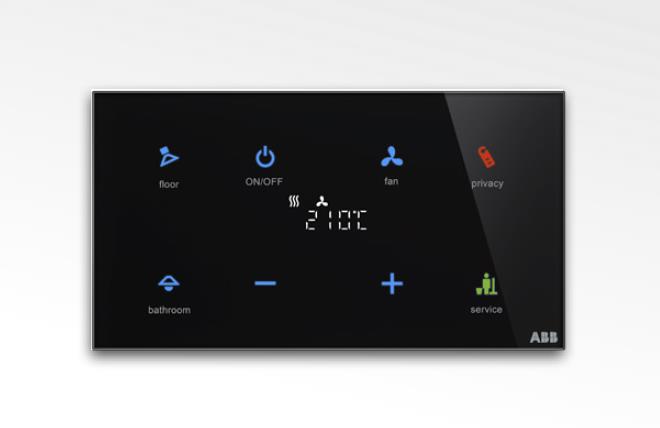
⭐ Overview: The ABB Tenton is a unique entry on this list – a KNX-based smart room control unit that performs thermostat functions and much more. KNX is a prevalent open protocol in Europe and upscale buildings worldwide for lighting, HVAC, blinds, and more, and Tenton is ABB’s flagship KNX room controller. It’s a 3-in-1 sensor device, housing temperature, humidity, and CO₂ sensors in one sleek wall panelnew.abb.com. The Tenton can directly control HVAC actuators via the KNX bus (e.g., fan coil valves, VAV dampers, radiant floor loops) while simultaneously acting as a user interface for lighting and shading – effectively consolidating multiple controls into one elegant unitarchitonic.comarchitonic.com. It features an array of capacitive touch buttons (in 6-gang, 8-gang, 10-gang, or 12-gang configurations) that are customizable for various functions – for instance, adjusting temperature setpoint, switching HVAC modes, dimming lights, or calling predefined scenes. A central display on the device provides temperature and HVAC mode readouts. The ABB Tenton is part of the ABB-i-bus® KNX lineup, ensuring interoperability with KNX-compatible systems from hundreds of manufacturers. With KNX’s decentralized architecture, each Tenton unit communicates with other KNX devices (like presence sensors or window contacts) directly on the bus, enabling robust automation logic without a single controller bottleneckoptigo.netoptigo.net. The focus of Tenton is on energy efficiency and flexibility: by measuring CO₂ and humidity in addition to temperature, it can optimize indoor air quality and comfort automatically. ABB highlights that integrating these multi-sensors can save ~30% energy by reducing device count and improving control strategiesknxpoint.comknxpoint.com. In sum, ABB Tenton is the go-to “smart thermostat” for KNX installations where integrated control of climate and other room functions is desired in a clean, unified interface.
🔧 Key Specs:
- Integration: Native KNX TP1 communication (twisted pair bus) – fully interoperable on the KNX standard. Can be configured via standard KNX software (ETS). KNX inherently allows integration of HVAC, lighting, blinds, security on the same networkoptigo.netoptigo.net. The Tenton also works with ABB’s free@home® system (a simplified smart home version of KNX) for residential applicationsarchitonic.com. If integration with BACnet or other protocols is needed, KNX-BACnet gateways can bridge (but within KNX ecosystems, no gateway is needed).
- HVAC Control: Acts as a KNX room temperature controller (RTC). It has a built-in PI control algorithm to maintain setpoint by commanding KNX actuators (e.g., valve drives, damper actuators) – essentially serving as the thermostat brain on the KNX networkglobal.abbarchitonic.com. Supports multiple HVAC modes (comfort, standby, eco, building protection) as per KNX standard HVAC objects. Because it’s KNX, it doesn’t have “hardwired” HVAC outputs itself; instead it sends KNX commands to relevant equipment actuators (so the actual HVAC wiring is at a central panel or VAV controller). This makes it very flexible and low-voltage only at the wall unit.
- Smart Features: 3 Sensors in 1: Temperature, relative humidity, and CO₂ (with VOC) sensing are integratedarchitonic.com. This enables precise climate control and indoor air quality monitoring. For example, it can trigger increased ventilation via KNX-controlled dampers when CO₂ rises (demand-controlled ventilation)architonic.com. It has a presence detection input (via separate KNX motion sensor or via manual presence button) to switch between comfort and standby modes for energy saving. The device supports scenes and multi-function buttons – e.g., an “Eco” button could lower setpoint, turn off lights, and close blinds in one press (since it can send multiple KNX commands). An “All Off” scene could put the room into deep setback and off state when leaving. The Tenton’s versatility in programming KNX logic is a major asset for energy efficiency and user convenienceknxpoint.comarchitonic.com.
- User Interface: Capacitive touch buttons arranged around a central display. The number of buttons depends on model (up to 12 touch areas)new.abb.com. Icons on the buttons (lighting, blinds, plus/minus, power, etc.) are laser-etched and there’s an LED backlight behind each button that can illuminate or change color based on status. The small OLED or LCD display in the middle shows temperature (and optionally humidity or CO₂ level, or mode symbols). Custom labeling: ABB provides a tool to print custom labels or icons for the buttons if needednew.abb.com. The design is minimalist and flat, available in several finishes (studio white matte, aluminum silver, black matte, etc.) to match high-end interiorsnew.abb.comnew.abb.com. The interface might not be as immediately intuitive as a big touchscreen, but once configured, it consolidates many controls elegantly.
- Installation: Mounts in a standard European electrical box (flush mount) or surface mount box. Needs KNX bus connection (low voltage 30V). No additional power supply needed (draws power from KNX bus). Commissioning is done via ETS software where integrators set up group addresses for all button functions and link to other KNX devices. It’s a specialist job – typically done by KNX system integrators.
- Extras: Flexibility & Scalability: Because KNX is decentralized, you can add dozens of these and the logic is spread out; no central failure will take down all thermostatsoptigo.net. Integration with other systems: Many commercial buildings use KNX for lighting and shading – Tenton can control those too (for example, up/down commands for KNX motorized blinds are just another button assignment). Security: Supports KNX Data Secure for encrypted communication (important as buildings get more connected). Future-proof: KNX is a 30-year-old standard continuously updated – Tenton can be reprogrammed for new uses if rooms repurpose.
🧪 Scoring Breakdown:
- Integration & Protocols: 8/10 – It’s dedicated to KNX, which is superb if you use KNX (interoperable with hundreds of devices)optigo.netoptigo.net. But it doesn’t natively do BACnet/Modbus without an external gateway. In the KNX world, though, it’s top-tier.
- HVAC Control & Flexibility: 7/10 – As a thermostat controller, it does standard temperature control very well and multi-zone coordination via KNX. But it lacks some of the heavy HVAC sequencing of others because it assumes a lot is handled by central plant. It’s best for zone control. However, being able to combine HVAC with lights/blinds scenes is a flexibility others don’t offer in one device.
- Smart Sensors & IAQ: 10/10 – Few thermostats come with a CO₂+VOC sensor built-inarchitonic.com. This allows direct monitoring of air quality in each room – huge for modern green buildings. Humidity sensing as well means it can prevent over-humidification or prompt dehumidification if KNX-controlled equipment supports it. Truly a holistic comfort sensor.
- User Interface & Management: 7/10 – UI is clean but mostly icon/button-based, which can have a learning curve for users. No app (unless integrated via a KNX IP interface to a smart home app, etc.). Management is through the KNX system – typically an on-site server or visualization can read/write to it. Great for integrators, but end-user facility managers would interact via a KNX dashboard.
- Installation & Retrofit: 8/10 – In KNX projects, installation is straightforward (two-wire KNX bus, no separate power). Retrofits into KNX buildings or those willing to adopt it – but if the building isn’t KNX, adopting this means wiring a KNX bus (hence one point off for general retrofit convenience). Within its domain, it’s as easy as any wall switch/panel.
- Reliability & Support: 9/10 – ABB (and its Busch-Jaeger brand) are reputable in building controls. KNX devices are generally long-lasting and since logic is distributed, the system resilience is highoptigo.net. Support is via ABB’s KNX team and a large community of KNX integrators.
- Value for Commercial: 7/10 – The device itself is moderately expensive (a few hundred dollars each), and one might need fewer devices overall because it consolidates functions. For premium projects, the value is there: it simplifies wiring (one bus for all control) and saves energy by integrated approachknxpoint.comknxpoint.com. For budget-conscious projects or ones not already on KNX, it may not be the first choice.
👍 Pros:
- Integrated Multi-Function Control: One device handles HVAC, lighting, and blinds – reducing wall clutter and giving occupants a single point of control for comfort and ambiancearchitonic.com. This can enhance user experience in modern smart offices or hotel rooms.
- Comprehensive Sensing: Temperature, humidity, and CO₂ in each room allow granular climate control and air quality management. This is ideal for wellness-focused buildings aiming for certifications like WELL or LEED.
- KNX Ecosystem: Leverages the power of KNX – robust, interoperable, and decentralized (no single point of failure)optigo.net. The Tenton can easily interconnect with occupancy sensors, window contacts, fan coil actuators, you name it – if it’s KNX, it can work together.
- Customizable and Stylish: The button layouts and LED indications can be tailored to the room’s needs. Architects and designers appreciate the range of colors and the sleek look (flat panel with matte options)new.abb.com. The unit blends into luxury interiors much nicer than a plastic thermostat.
- Energy Efficiency Emphasis: By combining functions, you inherently optimize (e.g., one command for “away” can reduce HVAC and turn off lights). Studies cited by ABB show significant energy savings when such integrated sensors are usedknxpoint.comknxpoint.com. Also, KNX’s programming can ensure no overlapping heating/cooling between zones, etc.
👎 Cons:
- KNX Required: If your building isn’t already using KNX, adopting this just for thermostats is a larger commitment – you’d need KNX infrastructure and an integrator to program it. In North America, KNX is less common (though growing); in Europe it’s more standard.
- Complex Setup: Configuration is done via KNX engineering tools (ETS software), which requires trained professionals. It’s not something the average HVAC technician will program – it falls to a controls/KNX specialist.
- Limited Display Info: The screen is small and text-based (just shows temps and maybe mode icons). Users might miss the rich info or graphics a full touchscreen thermostat could provide. It’s a conscious design trade-off for minimalism.
- No BACnet/Modbus: For integration to non-KNX BMS, a gateway is needed – extra cost/complexity. Direct integration is limited to KNX or systems that speak KNX via interface.
- Button Interface Learning Curve: While the buttons can do many things, users need to understand what each does (especially if custom-labeled). Without proper icons or labeling, there could be confusion (though ABB’s customization tries to mitigate that).
🏁 Bottom Line: ABB’s Tenton KNX sensor/controller exemplifies the philosophy of European smart building control: multi-functional, highly networked, and design-conscious. It earns its spot in the Top 5 by addressing an important segment – projects centered on the KNX protocol and integrated automation. If you’re building or retrofitting a premium office or hotel in a KNX environment, the Tenton can serve as thermostat, air-quality monitor, light switch, and blind controller all in one – an elegant solution that impresses occupants and meets energy goals. While it’s not a fit for every scenario (non-KNX buildings would find more straightforward choices), it underscores why BACnet isn’t the only game in town for building integration. By focusing on KNX compatibility alongside the other picks’ BACnet/Modbus strengths, we recognize the global nature of smart thermostat needs. In sum, ABB Tenton is the best-in-class for KNX-based smart climate control, bringing together comfort and efficiency with European flair.
Conclusion
When it comes to smart thermostats in commercial and light-commercial settings, integration capability is king. The top choices above each excel in connecting HVAC control with broader building systems through open protocols – whether it’s BACnet/IP in a school, Modbus in a factory unit, or KNX in a cutting-edge office. By prioritizing BACnet, Modbus, and KNX compatibility, we ensure these devices won’t live in isolation but rather function as part of a cohesive Building Management System, which is crucial for scaling efficiency and centralizing controloptigo.nettrane.com.
In summary:
- The Distech ECY-STAT offers the ultimate programmability and IP connectivity for those who need a thermostat and BAS controller in one.
- The Honeywell TC500A proves that user-friendly doesn’t mean feature-light – it marries advanced HVAC control with cloud convenience, ideal for multi-site businesses.
- The Johnson Controls TEC3000 shows how a solid, no-nonsense approach can yield big gains in ventilation and retrofit ease, addressing post-pandemic indoor air quality needs while saving energy.
- The Schneider SE8000 demonstrates unparalleled integration flexibility (BACnet and Modbus) and is a top pick for heavy retrofit scenarios and multi-protocol environments.
- The ABB Tenton reminds us not to forget KNX – delivering a sophisticated, design-forward solution for integrated climate and ambiance control in the smart buildings of tomorrow.
Each of these top 5 thermostats brings something unique, but all share a common thread: they enable smarter buildings through communication and automation. By choosing a thermostat that speaks the language of your building (be it BACnet MSTP on an older bus, BACnet/IP over Wi-Fi, Modbus RTU to equipment, or KNX for whole-building synergy), you invest not just in temperature control, but in a more efficient, responsive, and intelligent environment for years to come. And that means happier occupants, easier facility management, and a healthier bottom line through energy savings.